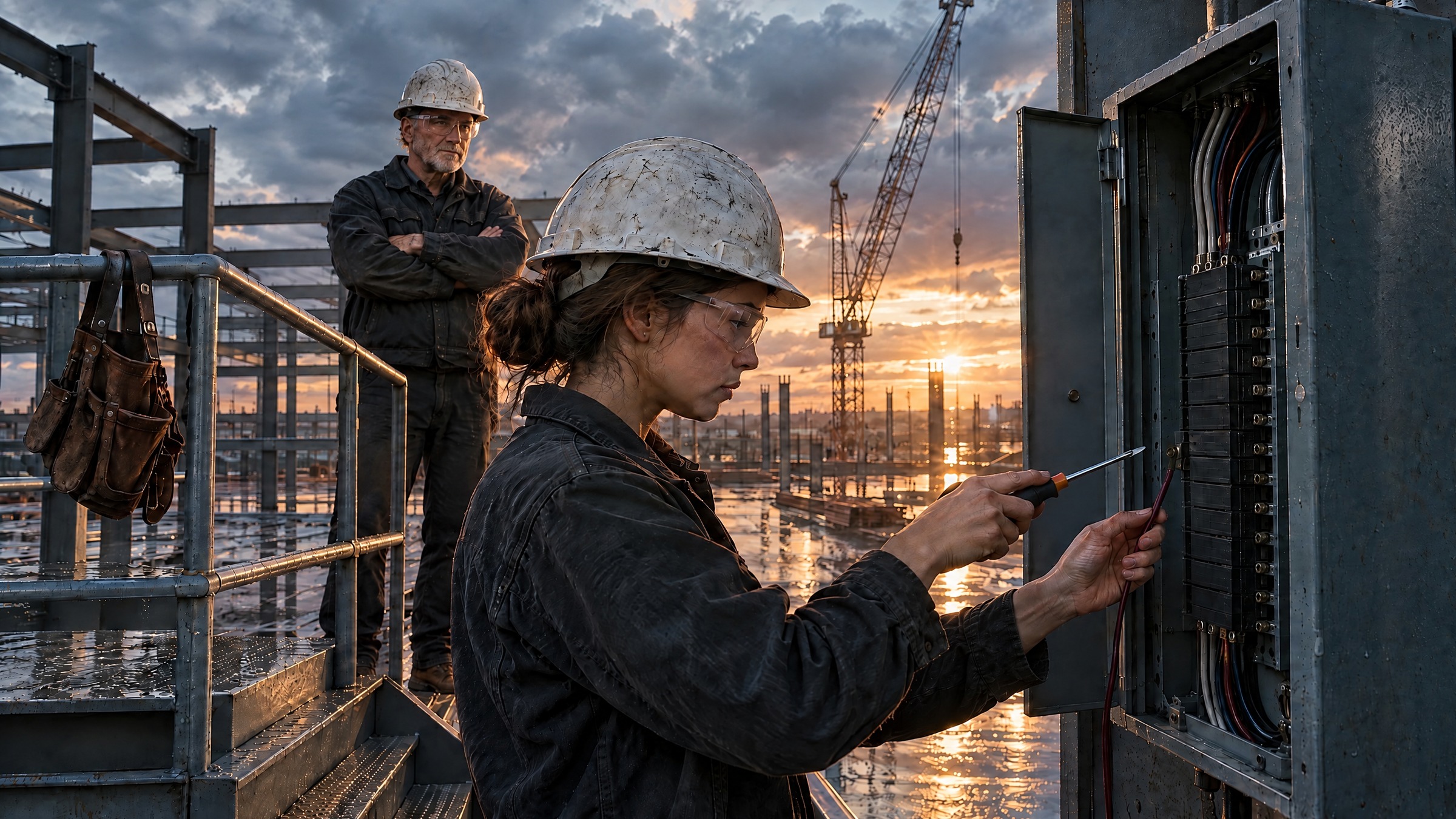
America didn’t just offshore the work; it broke the chain that taught the next generation how to do it.
Someone who started by sweeping the floor could end up supervising it. A machinist spent thirty years learning what no textbook captures, then stood beside an apprentice and handed it over. Around the plant grew machine shops, trucking firms, contractors, hardware stores, and banks, each run by someone who had learned the trade by doing it. Work built skill, skill built independence, and independence built towns where a mechanic could open his own shop and an electrician could become a contractor.
Over several decades, much of that disappeared. Not all of it: America never stopped making things. But enough went that we are only now counting the cost, and what it might take to get it back.
What disappeared with the factories
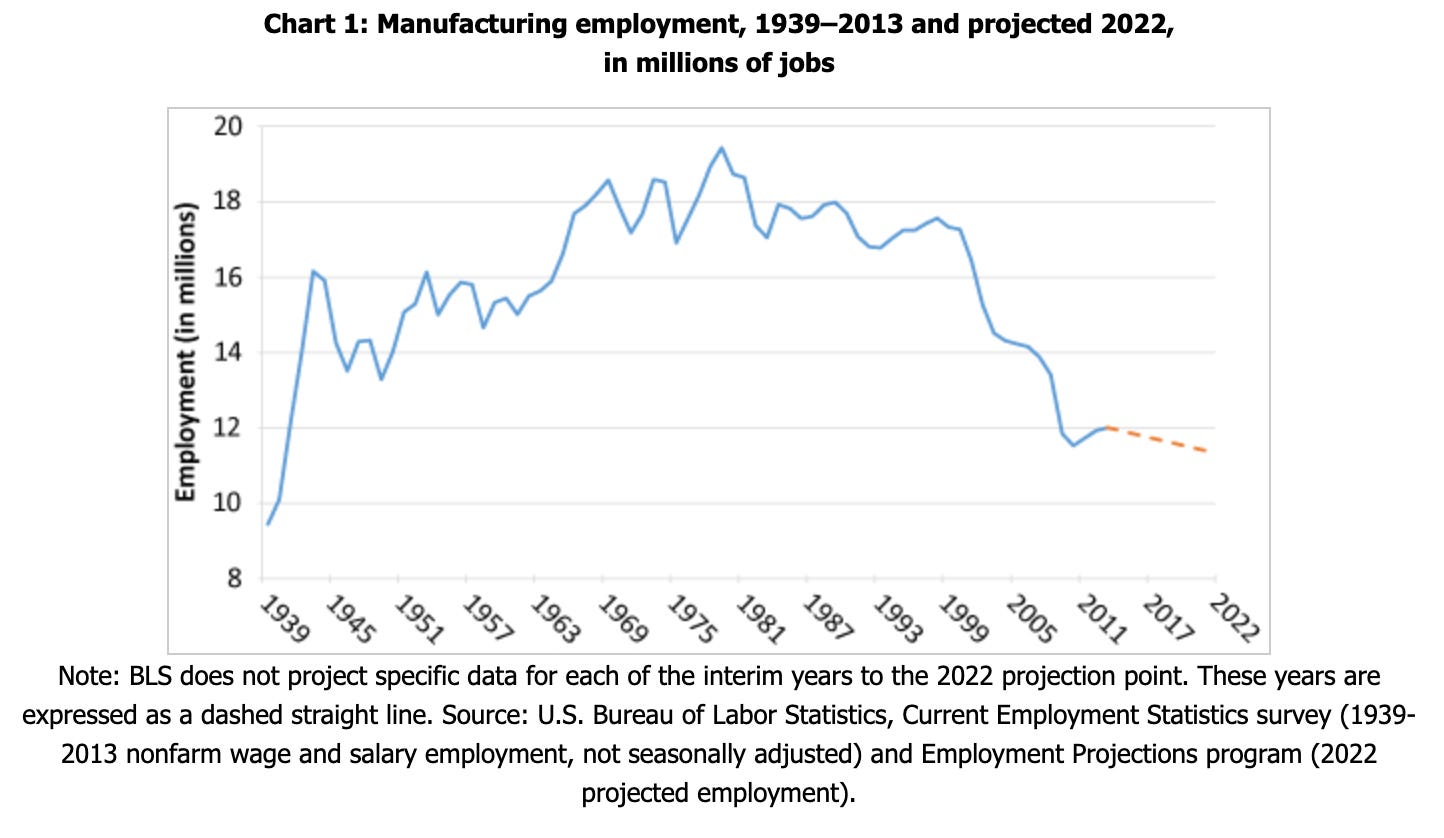
The numbers take a lifetime to see. U.S. manufacturing employment peaked at 19.6 million in June 1979. By June 2019 it was 12.8 million, a loss of about 6.7 million jobs.1 The worst stretch began in 2000. By 2010, almost six million manufacturing jobs had disappeared, roughly a third of the sector.2 The Bureau of Labor Statistics lists several causes: productivity gains from technology, recessions, and foreign competition, including companies that moved production overseas because the work cost less there.
Finished goods kept showing up on American shelves, which made the loss easy to miss. What went missing was upstream: the apprenticeship that never started, the machine shop that lost its biggest customer, the supplier that closed, the expert who retired with no one standing nearby.
The skills nobody wrote down
The plant was only part of it. The same education ran through communities. When I was young, my neighbors knew how to do several things and did more than one of them well. They worked with their hands and took pride in what they produced. A teacher ran cattle and put up his own hay every year for decades. A mid-level manager at a local company was a master mechanic, and there was almost always a car up on the racks in his home garage. The butcher at the grocery store did custom cutting for neighbors on his own time. Most families I knew raised their own meat, kept a garden, canned or froze what they grew, and shared or sold the extra.
Day jobs fed the family, and nights and weekends belonged to something they loved doing.
They earned a little on the side, but they kept coming back for a passion with a purpose: to create something that filled a need and matched an interest. Some taught it to their own kids or to a neighborhood kid who asked. They produced far more than beef, hay, and repaired cars. The work of their hands returned the fruit of their labor: something finished, useful, and their own. That was ordinary then, and it is how a community kept its know-how: spread across hundreds of hands, none of it written down. I still know people who live that way.
An industrial economy stores its knowledge in people: their eyes, hands, habits, and relationships. The philosopher Michael Polanyi put the problem in one line: “we can know more than we can tell.”3 Most of what a master machinist knows never made it into a manual, so it can be passed down only as it was learned, in person and over time. When that chain breaks, rebuilding takes far longer than reopening a building.
The factories are coming back
Building has started again. Apple has committed $600 billion to U.S. investment over four years and launched an American Manufacturing Program to bring more of its supply chain home, with chip suppliers such as Texas Instruments and Amkor on its list.4 Part of that is $2.5 billion for Corning’s plant in Harrodsburg, Kentucky, where it will make all the cover glass for iPhones and Apple Watches.5 Apple says the shift will raise Corning’s manufacturing and engineering workforce there by 50 percent. Stellantis has announced $13 billion in U.S. investment across Illinois, Ohio, Michigan, and Indiana, with more than 5,000 additional jobs planned.6
Not every announcement will unfold as promised, and press releases are cheap. But companies are putting real money behind the idea that where you make something matters. Every plant they build needs people who know how to run it.
The shortage already has names
Those people are the harder part. For decades, we told young Americans that the future belonged to the college-educated knowledge worker, and now the country is short on the people who install, maintain, and repair what everyone else depends on.
The Bureau of Labor Statistics projects about 72,700 openings for electricians every year over the next decade, many of them replacing workers who retire or change careers, and the median electrician earned $63,190 in 2025.7 For industrial machinery mechanics, maintenance workers, and millwrights, the job outlook projects about 51,900 openings per year and 14 percent growth through 2035, faster than the economy overall.
Industrial machinery mechanics alone earned a median of $64,100 in 2025.8 Across all installation, maintenance, and repair work, the figure is about 569,000 openings a year.9 Even in machining, where total employment is not expected to jump, about 30,400 openings a year remain for machinists and tool-and-die makers, mostly because experienced workers retire or leave.10
Behind each number is a specific need: an employer who cannot find a technician, a homeowner whose contractor will not call back, or an owner ready to retire with no one to sell to. A shortage frustrates those looking. It looks very different to someone who can supply what is missing.
What experience knows that training cannot teach
If you have spent decades in a trade, a plant, or a business that supplied manufacturers, you may hold the most valuable asset in the building. Industry let this knowledge walk out the door for forty years.
The people who kept it are now the supply, and the supply is short.
You know what that knowledge looks like. The contractor knows why the seemingly profitable estimate is not. The plant supervisor hears a bearing before the sensor flags it. The machinist reads a tolerance on a drawing and knows what it will do when metal meets machine. The owner knows which customer deserves credit and which promise the shop can keep. All of it was built, job by job and mistake by mistake. A growing industry needs it for more than the work itself: to teach apprentices, document the standards, build businesses, and turn instinct into methods the next crew can inherit.
The new plant raises the stakes. Modern factories run on automation, sensors, and software, so the most valuable worker understands both the machine and the work well enough to recognize when the system is wrong. Technology multiplies that person’s value. It cannot supply the knowledge itself.
You are not the student in this story. You are the source.
Some things are learned standing beside a master
We spent decades treating education as a classroom, a degree, and a credential. For many people, that route is excellent. It was never the only one. People have taught skills another way for thousands of years: watch, try, get corrected, practice, master, teach. An apprentice electrician beside a master is being educated. So is a welder learning how metals behave under heat, or a future owner watching an experienced contractor handle a difficult customer. The knowledge moves from one person to another rather than from a textbook to an exam.
Registered Apprenticeship is an earn-while-you-learn model that ends in a credential and higher pay.11 Public money is starting to follow. The Workforce Pell program, new this year, lets Pell Grants cover qualifying short-term programs for in-demand occupations.12 The Department of Labor is directing apprenticeship funding toward manufacturing, construction, shipbuilding, semiconductors, nuclear energy infrastructure, and information technology. In January, it launched a $35.8 million American Manufacturing Apprenticeship Incentive Fund to help manufacturers of every size build programs.
Money helps, but the model it supports—one person teaching another at the bench—works only if the person with the knowledge shows up. Start with one job. Take someone along, explain each decision, and have them write it down.
Find the skill the market has forgotten
A factory is a payroll and a web of businesses. Someone pours the concrete and wires the building. Someone fabricates replacement parts, hauls materials, manages insurance and accounting, recruits and trains workers, finances the expansion, writes the software, and fixes the trucks. Most of those businesses are small, and each began when someone noticed a problem others accepted.
If you are weighing your next move, start with two simple questions: what are you good at, and what do you enjoy doing? Many people I grew up around answered both by taking on a second trade on nights and weekends, and many businesses start exactly that way: one skill, one garage, and the first customer who asked.
Then look for where that skill meets a need. A job opening shows you where someone else has already found an opportunity. A need lets you find your own: a plant with no local source for a replacement part, a contractor booked out six months, or an owner who needs a succession plan and a buyer. Ask where the needs are before you ask where the jobs are. You need not be a tradesperson, either. People who can organize, finance, sell, negotiate, and manage are often what a good craft business is missing.
The next generation needs what you know
The word for all this is renaissance, French for rebirth: new work built from what is returning, by people who remember how it was done. The 1955 factory is gone, and nobody should want its safety record back.
The country needs more than one route, and insisting on a single one was part of the problem. It needs more apprentices who become masters, masters who become teachers, and owners who build something their crew can point to at the end of the day and say, “We made that.” That includes the eighteen-year-old told that only a four-year degree is respectable, the forty-year-old who has mastered a trade and never thought of themselves as a founder, and the sixty-year-old carrying knowledge that a younger generation does not yet know it needs.
America can rebuild a plant in a few years. It cannot rebuild what a master knows once that person is gone. Whether that knowledge survives depends on the person who holds it and on anyone willing to learn it from them—while there is still time.