
#### > TL;DR
Socialism and fascism start from opposite promises and arrive at the same conclusion: someone other than you decides what you own. In November, protesters tried to block Anthropic's public stock offering, and former Labor Secretary Robert Reich urged Democrats to lay the groundwork for nationalizing SpaceX and Starlink. The Fifth Amendment forbids taking private property for public use without just compensation, but that protection holds only as long as people insist on it. Your largest asset may be what you know. Claim it before someone relabels it.
On Monday, Nov. 9, five protesters blocked an employee entrance at Anthropic’s Manhattan offices.
Police arrested them. Their campaign’s rallying cry: “Block the IPO.” They wanted the maker of Claude to cancel its public stock offering. Their coalition’s petition went further, asking JPMorgan Chase, BlackRock, Vanguard, and the officials who run New York’s and California’s public pension funds to boycott the offering and pause all investment in AI and data centers.1
It didn’t work. On Nov. 18, Anthropic priced its shares at $83, above its expected range, and sold 980 million. Trading opened the next day.2 Anyone with a brokerage account can now own a piece.
So what were the protesters trying to stop?
Ownership. Yours, specifically.
The promise that defies the math
Socialism promises you everything—except the right to decide.
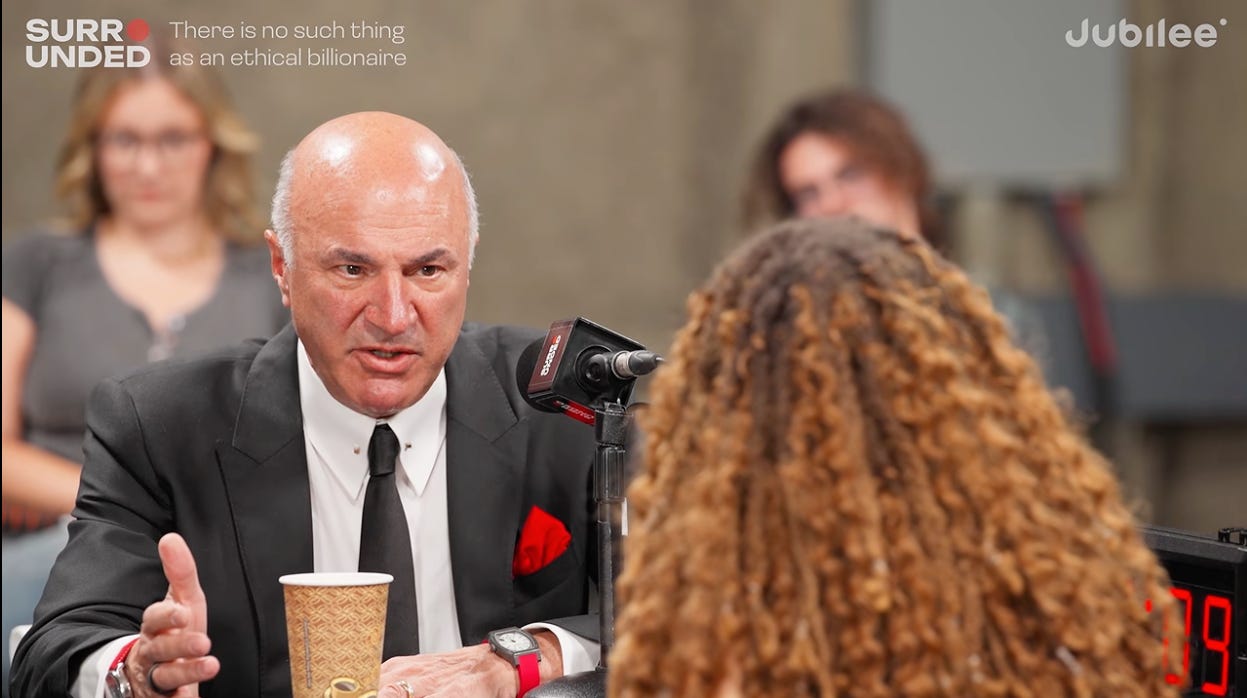
It sees wealth and never asks where it came from. Within a week of the protest, a young woman on a YouTube debate stage voiced that argument.
On Jubilee’s Surrounded, released Nov. 15, she sat across from investor Kevin O’Leary and said billionaires “don’t need that much money.” Should the government take it? “You know, in many ways, yes.” She would “rather the government redistribute that wealth or put a wealth cap on how much wealth one singular person is able to hoard and put it towards public uses.”3
“There are people that are dying,” she pressed. “There are people that are starving.”
O’Leary cut in. “I gotta tell you something. You’re really scaring me, and I’ll tell you why.” He called the idea of “Hi, I’m from the government and I’m here to help you” “a nightmare from hell,” because “every country that’s tried that ends up in a very bad place. That’s called socialism.”
“Oh, what’s wrong with socialism?” she asked.
“It doesn’t work. You run out of money. You run out of people you can steal money from after a while.”
“It’s not stealing,” she answered. “We all have a social contract to each other.”
He asked the only question that matters: “Who decides? Who decides?”4
He’s in good company. Margaret Thatcher made that point in 1976,5 and his “here to help you” line echoes Ronald Reagan’s “nine most terrifying words.”6
Wealth is a record of decisions. Someone saw a problem, took a risk, hired people, and got it right more often than wrong, for years. Seize the company, and you get the building. The people who knew what to do inside it walk out the door.
O’Leary put it plainly: “A cap on success is not part of the American dream. The American dream is you figure out [how] to solve problems for people around you. You start a business to do it.”
When was the last time socialism unleashed a wave of genuine innovation?
First the wealth. Then the control.
The argument has already moved past one IPO.
O’Leary offered an example: “If you don’t have internet and you’re on a farm, you’re pretty happy with Starlink right now.” Now someone wants Washington to take it.
The Democratic Socialists of America would go further. Their platform says major corporations and “essential industries” should be publicly owned.7 Author James Lindsay argues that “equity” is the old plan under a softer label.8
In October, former Labor Secretary Robert Reich told Democrats to start “laying the groundwork for nationalizing Starlink and SpaceX.” “It should be a public corporation,” he said. “We should not ever have that kind of power in one person’s hands.” He also claimed 75% of Musk’s wealth depends on taxpayers buying Starlink systems for the Pentagon. Fox Business reported he offered no evidence.9 Elon Musk replied on X: “Stealing companies is a serious crime. Prison for Reich.”10
Reich didn’t back down. On Nov. 16, he wrote that “when Democrats take over control of Congress starting January 3,” they should “gather evidence for busting or nationalizing his satellite monopoly.”11 Legal scholar Richard Epstein called the 75% claim “ludicrous” and noted Reich “has made no mention of compensating Musk and his fellow shareholders.” Epstein’s verdict: “His wealth, in short, is earned.”12
Musk founded SpaceX and built Starlink inside it. If a man that visible can be marked for seizure, so can you.
The only difference is the size of the target.
Different names. Same struggle for power.
Now for the part the protesters missed.
Fascism has a clear definition: dictatorial power that suppresses opposition by force and runs the economy through “collusion between state and corporate power.”13 Historian Robert Paxton adds that fascist movements work “in uneasy but effective collaboration with traditional elites.”14
Look again at the petition. A coalition that says it opposes billionaires asked the biggest names on Wall Street and public officials to act together against an offering that would let ordinary people buy in. Then its members blocked a door.
How did people who say they fight fascism end up using its tools?
Lindsay traces the answer to the Frankfurt School, a circle of Marxist thinkers formed to explain fascism’s rise and prevent its return. In that worldview, nearly anything can be called fascist: capitalism, corporations, the police, even an orderly society that most people like.15
Herbert Marcuse, the school’s best-known voice in America, gave the movement its permission slip. In his 1965 essay “Repressive Tolerance,” he wrote that “true pacification requires the withdrawal of tolerance before the deed, at the stage of communication in word, print, and picture.”16 Translation: be intolerant of anyone you’ve labeled intolerant, before they act. As Lindsay notes, the irony was lost on them: the theory both permits and requires “the forcible suppression of any opposition.”17
That is the mechanism.
The founders knew the danger
The young woman on Jubilee wanted private wealth put “towards public uses.”
The Fifth Amendment uses nearly her words, with a condition attached: “nor shall private property be taken for public use, without just compensation.”18 The Supreme Court has said the clause bars government “from forcing some people alone to bear public burdens which, in all fairness and justice, should be borne by the public as a whole.”19
In 2023, the Court applied it to Geraldine Tyler, a 94-year-old Minnesota woman. Her county seized her condo over a $15,000 tax bill, sold it for $40,000, and kept the extra $25,000. All nine justices ruled for her: “a government may not take from a taxpayer more than she owes.”20
The protection has bent before. In 2005, the Court let New London, Connecticut, take people’s homes and hand the land to a private developer. Justice Sandra Day O’Connor warned in dissent: “The specter of condemnation hangs over all property. Nothing is to prevent the State from replacing any Motel 6 with a Ritz-Carlton, any home with a shopping mall, or any farm with a factory.”21
One condo. One rocket company. Same principle. And it holds only as long as people insist on it.
What do you really own?
Most of us will never own a SpaceX. Almost all of us own something worth protecting.
O’Leary told the young socialist he would still hire her. “What I care about is can you do a job well? And that’s how America works.” That is what makes you valuable.
If you run a business or have spent decades in your profession, your largest asset may not appear on any balance sheet. It’s what you know: how you price a job, read a client, catch the mistake before it ships. And it’s what’s at stake.
No one has to nationalize what you know to take it. They can relabel it: “shared knowledge,” “training data,” “equity.”
Or they can write rules so heavy that only the giants can afford to comply, and everyone else goes out of business. The customer pays with fewer choices and higher prices.
Either way, the few who are left answer to the state, and the state answers to no one.
We’ve seen this move before—many times. It never starts with your shop. It starts with someone easy to resent. Then the door swings both ways, and every new rule makes the next seizure easier to justify.
Venezuela showed how fast it moves. Starting in 2007, its socialist government nationalized the electric companies and the biggest telecom company. Food companies, cement companies, and the largest steelmaker followed, along with majority control of foreign oil ventures.22
Socialism promises equality through redistribution. Fascism demands obedience through control. The methods differ, but the danger of concentrated power deserves scrutiny in either case.
A deed records ownership. A share establishes a claim. Neither means much if someone else holds the final authority over how you use what you’ve built.
The question isn’t merely what you own. It’s who gets to decide what ownership means.
I write about work, value, and independence every week at Line of Ascent. You can keep reading here: Work, Value & Independence.