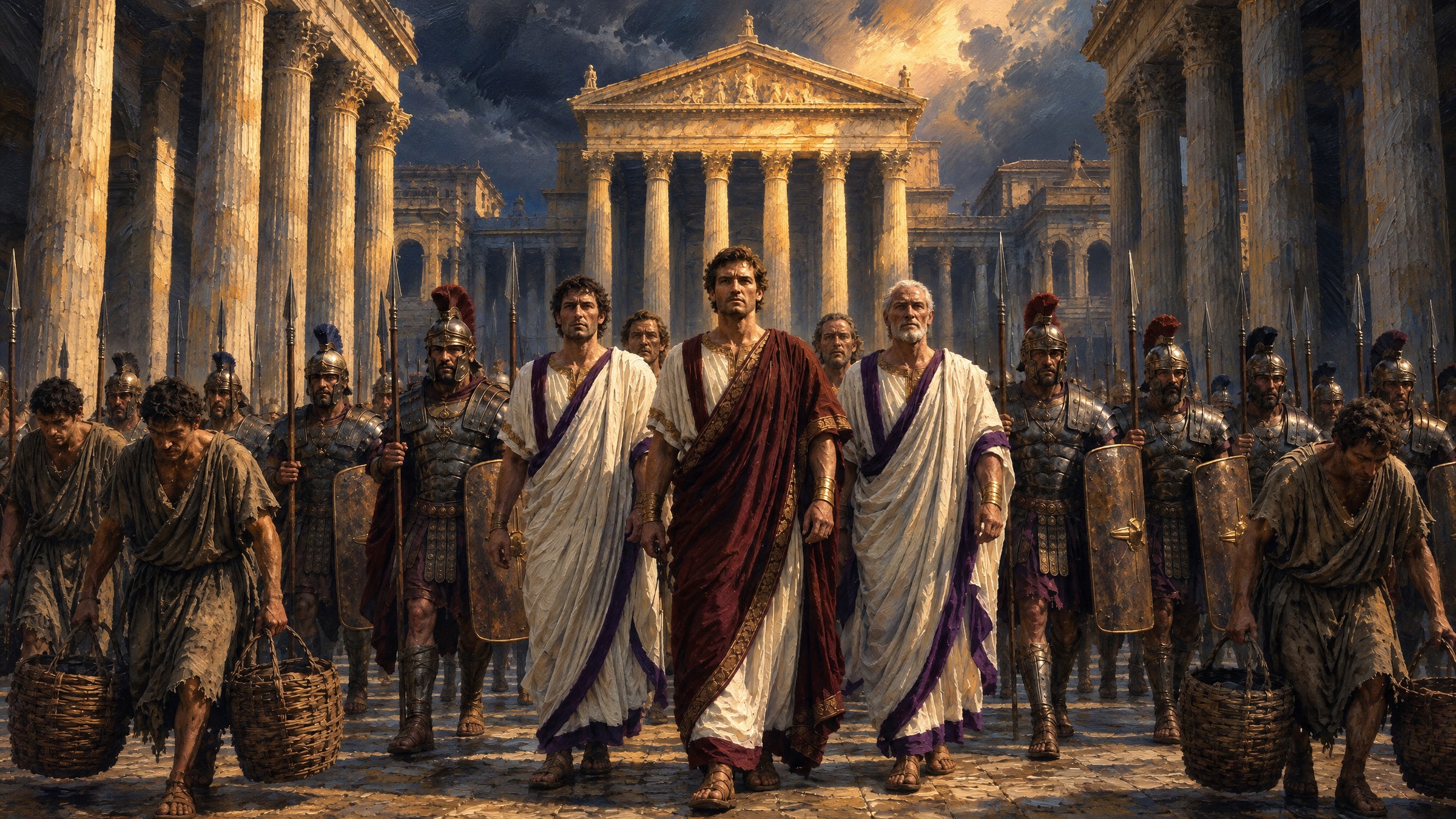
Rome had mastered the art of ruling the world, but not the human heart.
At the height of its power, Rome seemed capable of almost anything. It could conquer kingdoms, build cities, enforce laws, and command millions. But beneath its extraordinary achievements lay a problem no earthly authority could solve. Paul wrote to the Christians in Rome about that problem—and the only One who could answer it.
A promise no earthly power could make
Paul opens with good news, the very meaning of gospel. But this was no new invention. In Paul’s words, it is “not entirely new, but the fulfillment of the hope promised to us through his prophets in the sacred Scriptures.”1 God had promised this rescue long before Rome rose to power, and it centered on one Person: Jesus, the Christ, the Anointed One.
Then Paul makes a bold declaration in the heart of the empire:
“I refuse to be ashamed of the wonderful message of God’s liberating power unleashed in us through Christ! For I am thrilled to preach that everyone who believes is saved.”
Saved. The word implies danger, and Paul is about to reveal just how grave that danger is.
A man who believes himself healthy has no reason to seek a physician. So before Paul explains how God saves, he first shows us why we need saving.
When truth is obscured
“God in heaven unveils his holy anger breaking forth against every form of sin.” His anger is not arbitrary wrath, but a holy response to evil. “The wickedness of humanity deliberately smothers the truth,” though “from the creation of the world, the invisible qualities of God’s nature have been made visible… So then, this leaves everyone without excuse.”
Every sunrise bears witness to His presence. Every heartbeat, a gift.
Verse 21 then brings the indictment closer. God had made Himself known, yet humanity turned away. “When they knew and recognized Him as God, they did not honor and glorify Him as God or give Him thanks.”2
The distance was not God’s choice.
The great exchange
Then Paul’s language turns sharp. People traded God’s “glory and majesty and excellence” for images of created things, and they “exchanged the truth of God for a lie.”
Our generation bows at the altars of wealth, pleasure, status, and the state. I wrote about one of those altars in When Government Becomes God.
The cost of serving lesser gods
In verses 28–32, God gave them up “to a debased mind.” What follows reads like a modern news feed: envy, greed, arrogance, and every kind of evil. Paul does not soften the consequences. Those who practice such things “deserve to die,” yet “they not only do them but give approval to those who practice them.”3
The Psalms reveal where that path leads: “And everyone who trusts in these powerless, dead things will be just like what they worship—powerless and dead.”4 From the belly of the fish, Jonah warned: “Those who pay regard to false, useless, and worthless idols forsake their own [Source of] mercy and loving-kindness.”5
What we worship shapes what we become. What we trust determines what we surrender.
The stakes were life and death in ancient Rome, as they are now.
A debt no one could pay
Against that darkness, the brightest news begins to emerge. Chapter 2 closes every escape route. Those who condemn others while practicing the same sins have “no excuse.” Yet even in judgment, God’s mercy shines through: “God’s kindness is meant to lead you to repentance.”6
Chapter 3 delivers a verdict no one can escape: “None is righteous, no, not one.”7 The law reveals God’s standard, but it cannot give us the power to meet it. No amount of human effort can close the distance between a holy God and a fallen humanity.
Then, at the very moment all hope seems lost, light breaks through:
“But now, independently of the law, the righteousness of God is tangible and brought to light through Jesus, the Anointed One. This is the righteousness that the Scriptures prophesied would come… And now all who believe in him receive that gift.”8
God kept His standard and met it Himself:
“And when the season of tolerance came to an end, there was only one possible way for God to give away his righteousness and still be true to both his justice and his mercy—to offer up his own Son. So now, because we stand on the faithfulness of Jesus, God declares us righteous in his eyes!”9
The power no empire can give
Rome’s empire has fallen, but Paul’s letter still changes lives.
Our age commands markets, builds extraordinary machines, and shapes minds through media. Yet for all our progress, we remain powerless to save ourselves.
Human nature has not changed. Neither has our need for God.
Paul puts it plainly: “For sin’s meager wages is death, but God’s lavish gift is life eternal, found in your union with our Lord Jesus, the Anointed One.”10
Who decides what is righteous? Caesar never did. Neither does the crowd. That authority belongs to God alone. And for those who place their faith in Jesus Christ, His promise is clear. As one commentary summarizes: “Paul wrote Romans to communicate the grand themes of God’s grace and glory encapsulated in the gospel!”11
The message that confronted Rome still speaks to us. No achievement can earn salvation. No earthly authority can grant it. What humanity could never accomplish, God has freely offered through His Son.
If you have never received that gift, the invitation is as personal today as it was two thousand years ago. Believe in Jesus Christ. His grace is still offered, and the choice is yours.
Rome could command obedience. Only the gospel can set a soul free.
If this encouraged you, share it with someone who needs good news. For more reflections on faith, freedom, and the principles that endure, keep reading at Line of Ascent.